cart Shopping Cart    You have 0 items    Checkout

Mead Norton's Race to Vanuatu


Enjoying_the_lull.jpg


I have just returned from the inaugural Whangarei to Port Villa yacht race and still I can’t believe how wild the last two weeks have been.

It all started Thursday, June 21 at 10am when I got a phone call on my mobile from a woman speaking broken English with a heavy French accent, asking if I was able to do a sail race. In the ensuing conversation I was able to figure out that one of the boats competing in the race that I had been looking to participate in had just arrived in New Zealand from Noumea and they were still short one crewmember. I had been in contact with the race organizers a few months prior seeing if any of the boats then were short crew and they said that they would keep me in mind if they heard anything, but I had pretty much given up on it since the race was starting in two days.

It was very difficult to understand what she was trying to say and basically all I figured out was that there was a boat coming into Whangarei on Friday afternoon and I was supposed to meet it up there at the marina and that the skipper’s name was Jean-Luc. That was all I knew.

As soon as I got off the phone with her, I quickly made some frantic phone calls trying to re-arrange my appointments and called the race organizers to get more details on where to go in Whangarei. I also got on the phone to the travel agent to try to book a one way ticket back at the end of the race, which turned out to be the most difficult thing of all.

Once that was taken care of, or so I thought. I headed out to buy a few necessities and tried to do a bit of research on Vanuatu. All I knew about the island was that it was in the Pacific and that there was a Series of Survivor filmed there.

That took up the rest of Thursday and Friday morning as it was hailing in Auckland, I grabbed my gear and headed out the door to catch the bus to Ruakaka. The race was actually starting from Marsden Cove Marina, since 8 of the 10 boats competing in the premier race could not make it into Whangarei’s harbour due to their keels having too much draft to make it into the harbour.

Once I got on the bus, I was not able to concentrate on much of anything, because I was still waiting to hear if I had gotten a ticket back to Auckland. The travel agent finally called right before the bus stopped at Ruakaka to confirm that she had gotten me off the standby list and a flight home. I was so busy talking to her that I almost did not get off and would have ended up in Whangarei, which would have been a major hassle.

My first impression of 41 Sud when I finally made it to Marsden Cove was she looked like a fast, well maintained boat, both of which were to be proven true. It is a 40 foot Archumbald yacht that is only a year old and this was its first blue water race.

The crew on the other hand was much more of surprise. I knew the skipper was French, but I had assumed that at least some of the crew spoke English well, but it turned out that they did not speak much English and since I don’t know any French it made things a bit difficult at times.
Looking_forward_to_the_finish_1.jpg
Jean-Luc, the skipper reminded me of Jean-Valjean from Les Miserables: a man who has lived a hard life, but has a strong will and a happy disposition. He had wild unruly hair and a weather worn face. I knew he had done quite a few open ocean races, but I did not know that he was actually quite a famous sailor who placed 3rd in the 1996 Sydney to Hobart race that became famous for the ferocious storm that decimated the fleet.

Phillipe was his son who was the bowman for the race, and he is a student in France and did not say much since he was so jet lagged. He literally got off the plane from France in Auckland and jumped straight on board to sail it up to Marsden Cove.

Bruno was actually from Vanuatu and had just started sailing two years ago. Before that he had never stepped on board a sailboat and this was going to be his first off shore race.

Francois was also a newbie to off shore racing, and he was probably the most inexperienced person on the crew. In fact even at the end of the race, he was still having problems keeping his balance on the boat and would have to crawl around the boat on all fours at times while the rest of us were barely holding on.

Olivier was the last crewmember I met and in my mind I nicknamed him Lancelot, since he reminded me of a French knight. He always seemed to have well combed hair, was dark and strong features and carries himself with an air of confidence.

I was quite nervous once I realized how weak their English was and my French did not go past Bonjour, and Bon Appetite I wondered how we would communicate, but it never really became a problem. It did make for quite a few laughs though trying to communicate in broken English, French, and hand signals. By the end of the race, I did not really learn much French. I was able to pick up a few sailing terms so by the end of the race I knew what they wanted me to do without them having to say it in English and I would gauge how quickly or what needed to be done by the tone of their voice and where they were looking.

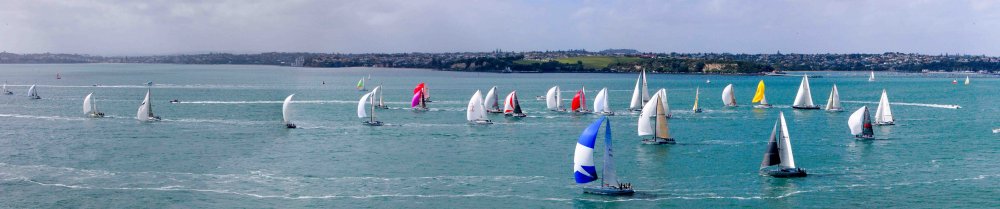
The race started on June 23rd at 2 pm and the night before at the pre-race dinner, the talk among all the sailors was the forecast for the race the next day, which predicted strong westerlies averaging 35knots with gusts up to 50 knots and heavy seas.

Unfortunately, for once the weather forcasters got it right. We started the race with a double reef in the main and the #2 jib while the thoroughbreds of the fleet – Revs, Bare Essentials, and Lightspeed had their mains fully raised. With so little canvas raised, they soon disappeared over the horizon. Once the wind settled down a bit, Jean-Luc still did not put up more sails and we were passed by some of the boats that were much slower than us.

Throughout that first night, the wind stayed steady around 25-30 knots and the ocean swells pitched the boat all over the place at one point in the night as we surfed down once of the swells we hit our top speed of the race at 15 knots. With the wind out of the West, we were running on a broad reach and the waves made the boat roll in such way that even Oliver who was quite used to being out in rough seas looked a bit green. For both me and Francis we spent the night continually feeding the fish off the stern. As I tried to get some rest on the floor of the cockpit using the ropes as a mattress, I really questioned the sanity of jumping on board a boat with a group of total strangers on such short notice to subject myself to those conditions.

In the morning, the waves had calmed down, but I still had not gotten my sea stomach but it was starting to get better. The wind dropped down to around 25 knots and Jean-Luc decided to open the boat up a bit and took out both reefs in the main and we were averaging about 8.5 knots.
Ocean_spray_1.jpg
To ensure that there were no problems throughout the race, all the boats were supposed to report into the race committee every twelve hours at 7 am and 7 pm via radio. But since 41 Sud was a French boat, it only had a VHF radio with a sixty-mile range. While the other boats could communicate with the race committee via their radios the whole time, we were to report in using the satellite phone. I was given that job to ensure there were no problems communicating with the race committee. The problem was that for the 1st two days, we could not get any signal on the satellite phone and had no contact whatsoever with either the race committee or the rest of the fleet.

On the 2nd night, I started the night sleeping in the same place as the 1st - curled on top of the ropes on the cockpit floor since I still did not trust my stomach. But with the wind settling down and the seas becoming more coherent, the ride was not quite as sickening and at 1am I had managed to keep down a couple of crackers and a few mouthfuls of bread for two shifts, and I knew I had gotten my sea stomach back.

I went down below and finally stripped off my wet weather gear for the 1st time in 48 hours and laid down in the aft starboard cabin and the next thing I knew, I was being woken up to take the 4am dawn shift.

At 6am, I was just getting off my shift when Jean-Luc asked me to try to raise the two boats that were still in sight on the VHF. I reported our position every 15 min, repeating the message two or three times for an hour before giving up. But then at 10am, Northern Rebel, the boat that crossed our stern fairly close earlier in the morning radioed us. The race committee had asked the fleet if anyone had seen us, since we had not been reporting in. Northern Rebel passed on our position to the race committee and informed the committee of our satellite phone issue.

We were still running our #2 jib, but we saw that one of the boats behind us had put up their j
gennaker and were getting closer. We followed their lead and as soon as we got the gennaker set, we quickly left both boats behind and by that afternoon, we had actually lost sight of them.

We kept the gennaker flying through the third night since the wind slowly died until we could barely keep the sails filled. Even in the light wind, we were able to sail past Norfolk Island in the night. Due to the light winds, on the fourth day, we changed our tactics. Instead of sailing a straight course to Vanuatu, Jean-Luc decided to head towards New Caledonia where there was more wind and use that to power us to Port-Villa.

We did find more wind on the fourth day, almost too much wind. By the afternoon, we were forced to drop down to the #3 storm jib and a second reef again and that was the most sail area we were able to carry the rest of the ride to Vanuatu.